


[HYUNDAI MARINE] Korea’s Blue Carbon Leadership Recognized in Canada, …

 aquon
aquon
본문
Professor Jong Seong Khim of the Department of Earth and Environmental Engineering at Seoul National University and CEO of AQUON delivered a presentation titled “Blue Carbon Research and Policy in Korea’s Tidal Flats” at the 16th Canada-Korea Conference on Science and Technology (CKC 2026), held on June 22 (local time) at the Hilton Whistler Resort & Spa in Whistler, British Columbia, Canada.
Source: HYUNDAI MARINE News (Korea)
Korea’s Blue Carbon Leadership Recognized in Canada, Opening a New Chapter in Korea–Canada Collaboration
CKC 2026 Special Session Highlights Tidal Flat IPCC International Recognition and the Establishment of a Joint Research Platform
June 24, 2026, 09:46
By Reporter Park Jong-myeon
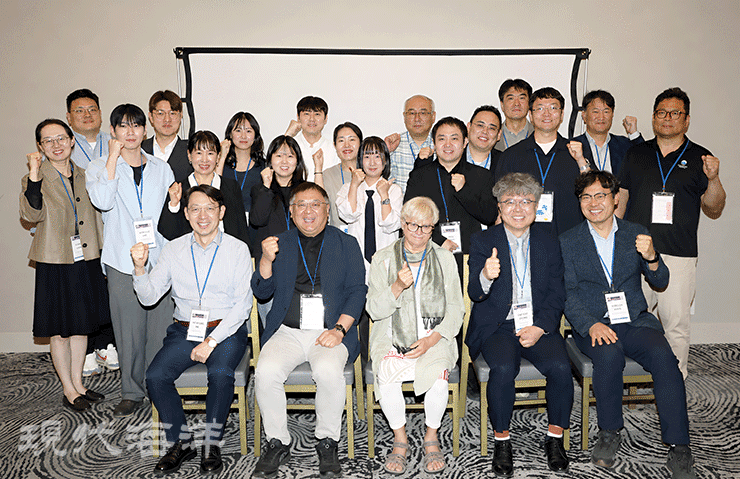
A special session on “International Cooperation for Blue Carbon” was held on June 22 (local time) during the 16th Canada-Korea Conference on Science and Technology (CKC 2026) at the Hilton Whistler Resort & Spa in Whistler, where researchers from Korea and Canada discussed pathways for international certification and the establishment of a joint research platform.
Photo by Park Jong-myeon
Marine scientists from Korea and Canada have launched a collaborative effort to secure international recognition of tidal flats and other emerging marine carbon sinks as official blue carbon ecosystems.
A special session on “International Cooperation for Blue Carbon” was held on June 22 (local time) during the 16th Canada-Korea Conference on Science and Technology (CKC 2026) at the Hilton Whistler Resort & Spa in Whistler, British Columbia, Canada. Researchers from both countries discussed pathways toward international certification and joint research initiatives.
CKC 2026 is being held from June 21 to 25 under the theme “AI-Arctic Synergy for Global Impact.” Jointly organized by the Association of Korean-Canadian Scientists and Engineers (AKCSE) and the Korean Federation of Science and Technology Societies (KOFST), the conference serves as a leading platform for scientific and technological exchange among governments, research institutes, universities, industries, and emerging researchers from both nations.
The special session brought together researchers from Korea and Canada specializing in marine ecology, physical, chemical and biological oceanography, big data, modeling, and artificial intelligence. Participants included members of the Blue Carbon Research Center for Climate-Adaptive Coastal Development Technologies, led by Professor Kim Jong-Sung of Seoul National University, who shared scientific evidence and collaborative strategies to support the international recognition of new marine carbon sinks.
The session was organized as a follow-up to the 63rd Session of the Intergovernmental Panel on Climate Change (IPCC) in 2025, where emerging marine carbon sinks, including tidal flats, were incorporated into the outline of future greenhouse gas inventory guidelines. Researchers emphasized that internationally recognized carbon sink status for tidal flats and related coastal ecosystems will require robust scientific methodologies, long-term monitoring data, and sustained international collaboration.
Participants agreed that strengthening bilateral research cooperation between Korea and Canada will be essential for developing internationally accepted accounting frameworks and accelerating the recognition of tidal flats as nature-based climate solutions.
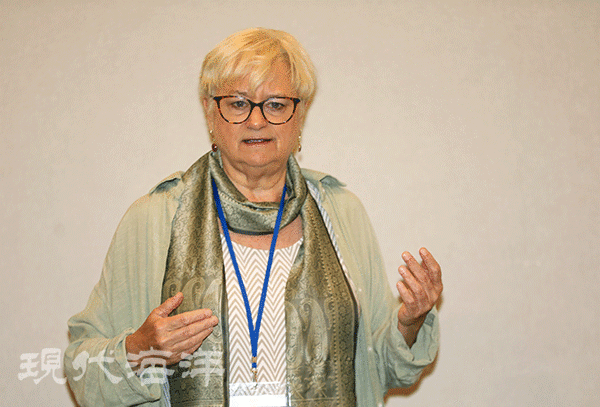
Professor Gail L. Chmura of McGill University, one of the world's leading authorities on blue carbon, presents her keynote address on the scientific foundations and global significance of coastal blue carbon ecosystems during the CKC 2026 Special Session on International Cooperation for Blue Carbon.
Photo by Park Jong-myeon
“Protection Comes Before Restoration”
The keynote address was delivered by Professor Gail L. Chmura of the Department of Geography at McGill University, Canada, one of the world's foremost authorities on blue carbon. Professor Chmura served as a lead author for the coastal wetlands chapter of the IPCC Guidelines for National Greenhouse Gas Inventories and has played a pivotal role in integrating blue carbon ecosystems into international greenhouse gas accounting frameworks.
Among Korean blue carbon researchers, Professor Chmura is regarded not merely as an international expert but as a key figure whose work has significantly influenced the understanding of international standards and scientific methodologies for blue carbon research.
In her presentation, “Assessing the Effectiveness of Blue Carbon as a Climate Change Mitigation Strategy: Canada's Approach,” Professor Chmura reviewed the current status of blue carbon research in Canada and delivered a clear message: “Protection should take precedence over restoration.”
She emphasized that protecting carbon already stored in coastal ecosystems is often more important than enhancing new carbon sequestration.
“For blue carbon ecosystems, preventing the loss of carbon that has accumulated in sediments over centuries to millennia is far more important than rapidly absorbing new carbon,” she said.
Professor Chmura explained that although Canada possesses the world's longest coastline, stretching more than 243,000 kilometers, research efforts face significant challenges because coastal environments differ substantially across the Atlantic, Pacific, and Arctic regions, many of which are remote and difficult to access.
Comparing salt marshes, seagrass meadows, kelp forests, seabed sediments, and intertidal tidal flats, she cautioned that applying global average values or simplified models uniformly across regions could lead to an overestimation of blue carbon's climate mitigation benefits.
She noted that additional research is needed to better understand the long-term carbon storage and sequestration potential of seagrass ecosystems and kelp forests. At the same time, she identified unvegetated seabed sediments and intertidal tidal flats as highly promising yet understudied blue carbon systems.
Referring specifically to the Bay of Fundy, Canada's iconic tidal-flat ecosystem known for having the world's highest tidal range, Professor Chmura pointed out that data on carbon storage and greenhouse gas fluxes remain surprisingly limited.
“Even in the Bay of Fundy, one of the most extreme tidal environments in the world, there is still a significant lack of data on carbon storage and greenhouse gas fluxes. In this area, there is clearly much that Canadian researchers can learn from their Korean counterparts,” she said.
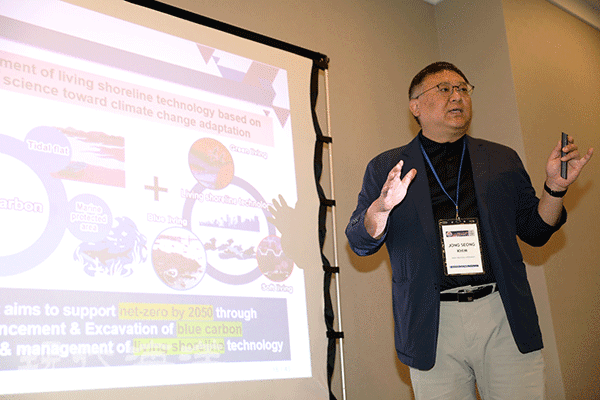
Professor Jong Seong Khim of Seoul National University presents Korea’s latest research achievements and policy initiatives on tidal-flat blue carbon, highlighting the scientific foundation and international significance of Korea’s efforts to secure global recognition of tidal flats as blue carbon ecosystems.
Photo by Park Jong-myeon
“Korean Blue Carbon Moving Toward International Standards”
Professor Jong Seong Khim of Seoul National University presented “Blue Carbon Research and Policy in Korea’s Tidal Flats.”
“Ten years ago, we were still learning the basic definition of blue carbon,” said Professor Kim. “Today, Korean tidal flats are being recognized internationally as an emerging blue carbon ecosystem and are becoming an important pillar of the nation’s carbon neutrality strategy.”
Korean researchers have developed a nationwide blue carbon inventory by combining field surveys, satellite remote sensing, and standardized operating procedures (SOPs) across major tidal-flat regions, including Ganghwa, Yeongjong, Garorim Bay, Shinan, Suncheon Bay, and the Nakdong River Estuary.
“Carbon sequestration observed in only a few locations is insufficient for recognition as a national greenhouse gas sink,” Kim explained. “The significance of Korea’s work lies in its nationwide-scale surveys and verification efforts, which have enabled the quantitative assessment of blue carbon resources.”
He emphasized that future priorities include evaluating emerging blue carbon resources—such as tidal flats, benthic sediments, and macroalgae—according to international standards and integrating them into national carbon-neutrality policies.
Professor Kim also noted that blue carbon research is expanding beyond carbon accounting toward broader Nature-based Solutions (NbS) and coastal management technologies. Follow-up projects led by the Seoul National University Blue Carbon Research Center aim to develop Living Shoreline technologies that enhance carbon sequestration while addressing coastal erosion, ecosystem restoration, and biodiversity conservation.
“Korean Research Could Shape International Standards”
Professor Kwon Bong-Oh of National Kunsan University discussed the progress and prospects of securing IPCC recognition for emerging blue carbon ecosystems.
“The IPCC methodology is not simply an academic report,” Kwon stated. “It serves as the international standard used by governments worldwide to quantify greenhouse gas emissions and removals. Without inclusion in the IPCC guidelines, carbon sequestration achievements cannot be formally recognized in national climate accounting.”
While the IPCC currently recognizes salt marshes, mangroves, and seagrass ecosystems as blue carbon habitats, Korean researchers have provided scientific evidence demonstrating the carbon storage capacity, management feasibility, and policy relevance of tidal flats. This has accelerated international discussions on incorporating tidal flats, benthic sediments, and macroalgae into future IPCC methodologies.
Professor Kwon reviewed the series of international discussions held at the Vienna Expert Meeting in 2024, the Copenhagen Scoping Meeting, the 62nd IPCC Session in Hangzhou, China, and the 63rd IPCC Session in Lima, Peru.
“We are now approaching the final stage of developing the international methodology,” he said. “If tidal flats and other emerging blue carbon ecosystems are ultimately included, the scientific achievements accumulated by Korean researchers will contribute directly to international standards.”
“Expanding Joint Research and Long-Term Collaboration”
The panel discussion was chaired by Professor Kap-Soo Chang of the University of Saskatchewan, a prominent Canadian marine physicist. Panelists included Professor Gail L. Chmura, Professor Kim Jong-Sung, Professor Kwon Bong-Oh, and Professor Ha Ho-Kyung of Inha University.
“Blue carbon represents a truly interdisciplinary field where climate action, marine ecosystem conservation, and international carbon policy converge,” Professor Chang noted. “Combining the research strengths of Korea and Canada could make a significant contribution to the development of international standards.”
The discussion identified three key priorities: ▲ Protection First rather than restoration alone ▲ Long-term data accumulation for international certification ▲ Expansion of international research networks
Professor Chmura emphasized that Canada’s intertidal tidal-flat research remains in its early stages and highlighted the need for stronger collaboration with Korean researchers.
Professor Jong Seong Khim noted that Korea’s standardized survey methodologies and nationwide database could serve as an important reference model for the development of new IPCC methodologies.
Professor Kwon added that the scientific evidence and international partnerships established by Korean researchers are already playing a significant role in the ongoing IPCC methodological development process.
Professor Ha stressed the importance of integrated oceanographic research that considers not only carbon sequestration but also sediment transport and broader marine environmental changes.
Participants agreed that the special session represented more than an academic exchange. It established a foundation for Korea–Canada cooperation in developing IPCC methodologies and securing international recognition for emerging marine carbon sinks, including tidal flats. They also agreed to continue promoting blue carbon special sessions and collaborative research through future CKC conferences while expanding regular exchanges among researchers and strengthening information-sharing networks.
Source: HYUNDAI MARINE News (Korea)
댓글목록0